
Pinterest® Research · Pinfluence Discover
How Many Pinterest® Pins Are Stolen? We Checked 69 Million Images
By Pinfluencing.com · Last updated
About 1 in 6 ranking images exists as more than one pin. Roughly 1 in 100 has been re-pinned by someone else with a different link. And when that happens, the original wins the search slot less than half the time.
We looked at every image behind roughly 91 million ranked pins in Pinterest® search, grouped the ones that are the same picture, and checked whether the copies point to the same place, a different place, or nowhere at all.
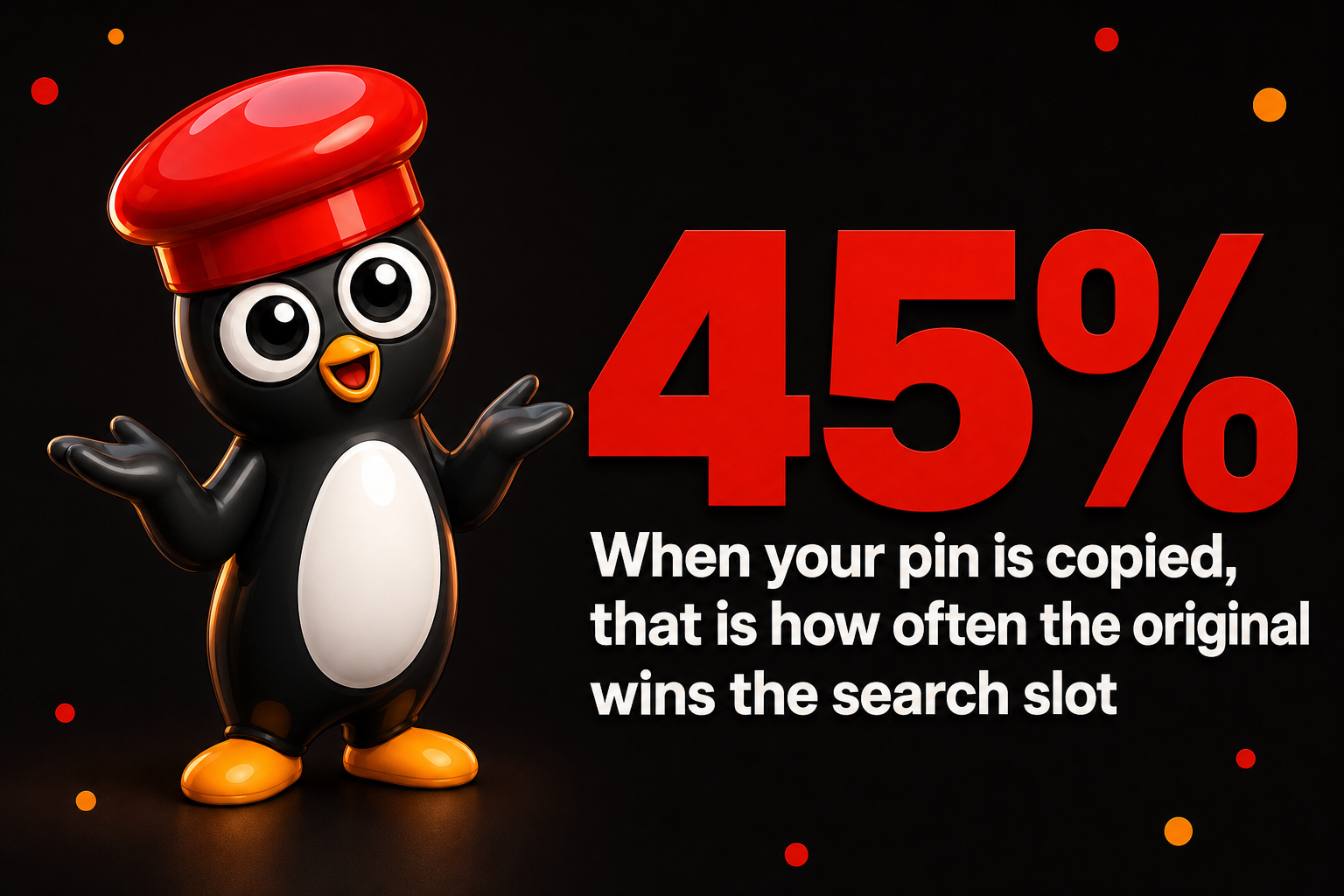
Most duplicates are ordinary repins. But around 600,000 images have been re-pinned by a different account with a different destination, and about 113,000 now send people to a completely different website. Pinterest shows each image only once per search, so those copies compete with the original for one slot, and the original wins it just 45% of the time.
Not sure whether your pins have been copied?
Most creators find out by accident, months later, when a familiar image shows up with someone else’s link on it. Intel’s Stolen Pins check compares your pins against the images we index and shows you every copy it finds, with where each one points. Free account, 7 days of Pro included, no credit card.
Check My Pins for CopiesKey findings
- One in six ranking images is a duplicate. Of 68.9 million distinct images in our index of ranked pins, 12.3 million (17.8%) exist as two or more pins. 32% of all ranked pins share their image with at least one other pin.
- Nearly all of that is normal repinning. 7.4 million duplicated images have no link on any copy, and another 4 million share a single link across every copy. Only 673,000 images (about 1%) have copies that disagree about where they lead.
- Around 600,000 images were re-pinned by someone else with a different link, and 113,000 of those now point to a different website entirely. A further 130,000 images have a copy by another account that links nowhere.
- Exact matching catches about two thirds of it. On pins we also checked with perceptual matching (which recognizes re-saved and re-compressed versions of a picture), we found 1.5 times as many duplicates. So the true figures are closer to 170,000 images sent to another site and over a million re-linked or de-linked.
- Pinterest shows each image once per search. Across 1.29 million searches, not one top-10 result set contained the same image twice. When your image has been copied, exactly one version gets each search appearance.
- The original wins that contest only 45% of the time. In 69,000 head-to-head cases (the original and one copy on a different site), the original was the version shown 45.2% of the time. Follower count did not decide it: the account with more followers won 50.3% of contests.
- Copies without a link take the slot more often than chance. When the same image exists with and without a link, the linked version got 33% of the appearances against the 44% you would expect.
- Duplicated images do not rank worse. They rank better. Images that exist as several pins averaged position 95 against 115 for one-of-a-kind images, in every follower tier. There is no visible penalty for an image existing many times; popular images simply get repinned.
- Among creators who checked, 94% found at least one copy. Across 66 Pinterest accounts that ran Intel’s Stolen Pins check, 62 had a copy of their image pointing somewhere else or nowhere. On average 4.4% of their pins had one, and their best-ranking pins were copied most.
What this means for you
If you publish original images on Pinterest, the base rate is reassuring: about 1 in 100 ranking images has been re-pinned with someone else’s link, and about 1 in 600 has been sent to a different website. This is not an epidemic. It is a steady background level, and it is spread across a huge number of one-time copiers rather than a few industrial ones.
The part that should change how you think is what happens next. Pinterest search shows one pin per image. So a copy is not a second listing sitting harmlessly beside yours; it is a rival for the single slot your image can hold, and it wins that slot about as often as you do. Whoever has more followers does not get a say. (Remember, a ‘lower’ position is better, and there is only one position per image per search.)
The practical consequence is that the pins most worth checking are your best-ranking ones. Among creators who ran a check, pins that ranked in a top 10 were copied more than twice as often as pins that did not rank at all. Copies find the images that are already working.
And the fix is not to make your image unique in some clever way. Duplicated images rank better, not worse, because being repinned is what popular pins do. The lever you control is the same one we keep finding across this series: the words in your title and description, measured directly in where to put your keyword on Pinterest. The image can be copied. The ranking signals around your pin cannot.
How common are duplicate images on Pinterest?
We started from the widest possible question: of every image behind a ranked pin, how many exist more than once?
| Image class | Images | Share |
|---|---|---|
| Appears on exactly one pin | 56.6M | 82.2% |
| Appears on 2 or more pins | 12.3M | 17.8% |
| all copies have no link | 7.4M | 10.8% |
| all copies share one link | 4.0M | 5.8% |
| copies point to 2+ different links | 673K | 0.98% |
| one link plus link-less copies | 190K | 0.28% |
So 17.8% of images are duplicated, but the moment you ask ‘do the copies disagree about where they lead?’ the number collapses to about one percent. Repinning keeps the link, and repinning is most of what is happening. 99% of duplicated images involve more than one account, which is exactly what you would expect: other people saving your pin is the point of Pinterest.
The size of the group matters too. Among images that exist as exactly two pins, 4.3% have copies with different links. Among images that exist as six to ten pins, that rises to 34%, and past ten pins it is over half. The more an image travels, the more likely at least one copy has been pointed somewhere new.
How many pins are actually copied by someone else?
To get at copying rather than repinning, we required three things: the copy is by a different account, the copy has a different destination from the earliest pin of that image, and (for the strictest cut) that destination is a different website. We treated the earliest-published pin as the original.
| Kind of copy | Copies | Images affected | Accounts |
|---|---|---|---|
| Different link, same website | 656K | 515K | 339K |
| Different website entirely | 141K | 113K | 108K |
| No link at all (original had one) | 166K | 130K | 145K |
| A link added to an image that had none | 91K | 74K | 80K |
Two of these rows deserve care before anyone calls them theft. ‘Different link, same website’ is dominated by marketplaces: 41% of it is Etsy listings re-pinned to other Etsy listings, and ten accounts are responsible for four in ten of those copies. On a marketplace the same product photo legitimately appears on many listings, and bulk pinning accounts re-post them constantly. That row is marketplace behavior, not evidence of anything.
‘Different website entirely’ is the opposite kind of number. 108,000 accounts made those 141,000 copies, and 93% of them did it exactly once. The ten most active accounts hold under 5% of the total. Copying an image to a new site is not something a handful of operations do at scale; it is something a very large number of people do one time each. That diffuseness is what makes it look like copying rather than syndication.
Timing tells the same story. Half of those copies appeared more than 200 days after the original, and 36% more than a year later. These are not automated re-posts racing the original; they are people finding an image that has been around long enough to circulate, which fits what we found in our pin age study about how long pins keep working.
See which version of your image is the one ranking.
Search any keyword in Pinfluence Discover and see the pins holding the top spots for it, plus the accounts behind them. If a familiar picture is ranking under someone else’s name, that is where you will see it. Free account, 7 days of Pro included, no credit card.
Show Me the Top PinsPinterest shows each image once per search
This is the finding that turns a curiosity into something that matters. We checked whether the same image ever appears twice in one search’s results.
| Result window | Searches checked | Searches with a repeated image |
|---|---|---|
| Top 10 | 1,289,303 | 0 |
| Top 25 | 1,289,303 | 54 |
Not one top-10 result set contained the same image twice, and only 54 top-25 sets did. Pinterest de-duplicates search results by image. Out of nearly 108 million combinations of a search and a duplicated image, only 2,697 showed two copies of that image anywhere in the results.
That means a copied image is a winner-take-all situation. Your pin and every copy of it are competing for one appearance per search. Only one of you gets it.
Who wins the slot: the original or the copy?
We took every image that has both an original and at least one copy sent to a different website, and looked at which version Pinterest chose to show. Average position is included, but the column that matters is who holds the appearances. (Lower position is better.)
| Version shown | Share of appearances | Expected | Avg. position | Reached top 10 |
|---|---|---|---|---|
| The original pin | 27.8% | 37.6% | 90.4 | 7.6% |
| Copy on a different website | 45.7% | 46.7% | 106.3 | 5.7% |
| Other copies (repins etc.) | 26.5% | 15.8% | 96.3 | 7.1% |
On average the original does rank about 16 positions better than its re-sited copies, and reaches the top 10 a third more often. But it holds only 28% of the appearances, below the 38% you would expect from its share of the group, because the original is also competing against ordinary repins of itself. The copy on another site gets almost exactly its random share. Pinterest is not favoring the original, and it is not penalizing the copy.
The cleanest test is the two-horse race: images that exist as exactly two pins, the original and one copy on a different website. There were 69,194 of those, with 393,969 search appearances between them.
| Cut | Appearances | Original shown |
|---|---|---|
| All appearances | 393,969 | 45.2% |
| Top-10 appearances only | 21,390 | 51.1% |
| Original’s account has more followers | 179,770 | 45.6% |
| Copier’s account has more followers | 148,717 | 44.0% |
| Copier has 10x the followers or more | 64,664 | 43.5% |
| Original has 10x the followers or more | 87,348 | 45.8% |
| Copy made within 30 days | 83,554 | 47.4% |
| Copy made a year or more later | 123,535 | 45.8% |
The original is the version shown 45.2% of the time. Inside the top 10 it edges to 51.1%. Neither followers nor timing moves it much: when the copier has ten times the followers the original still shows 43.5% of the time, and when the original has ten times the followers it shows 45.8%. Across all decided contests, the account with more followers won 50.3% of them, which is a coin flip. That matches what we found in our follower count study: follower count is not what decides where a pin lands.
By niche the range is narrow, from 41% (event planning) to 49% (architecture). There is no niche where the original reliably wins.
When one copy has a link and another does not
A specific version of the contest matters to anyone pinning for traffic: the same image with a link on one pin and no link on another. This is the ‘it links one place, then it links nowhere’ case.
| Cut | Appearances | Linked version shown | Expected |
|---|---|---|---|
| All appearances | 2,525,323 | 32.9% | 43.6% |
| Top-10 appearances | 170,836 | 35.9% | 42.3% |
The version with the link gets fewer appearances than its share, 33% against an expected 44%. Whatever is choosing between copies, it is not choosing the one that sends people to your site. If your image has been re-pinned without its link (which happens to 130,000 images by other accounts alone), the link-less version is the one more likely to be seen.
Do duplicated images rank worse?
A common worry is that Pinterest suppresses images it has seen before, so a copy of your pin drags the original down. The data says the opposite. We compared images that exist once against images that exist as several pins, across every ranked appearance.
| Pins sharing the image | Appearances | Avg. position | Reached top 10 |
|---|---|---|---|
| 1 (one-of-a-kind image) | 107.1M | 115.4 | 4.5% |
| 2 | 73.8M | 97.8 | 6.7% |
| 3 to 5 | 31.7M | 89.8 | 8.3% |
| 6 to 10 | 2.2M | 87.4 | 9.3% |
| 11 to 50 | 188K | 84.7 | 10.5% |
Images that exist as several pins average about 20 positions better than one-of-a-kind images and reach the top 10 half again as often, and the pattern holds in every follower tier (under 1,000 followers: 96 versus 116; over 10,000: 88 versus 115). This is not a reason to copy images. It is the natural result of repinning: the images people save are the images that were already doing well. What it does rule out is any visible penalty for an image existing many times.
Where do copied images come from, and where do they go?
For copies sent to a different website, we looked at both ends of the trip. Volume alone is misleading, because the biggest sites are simply big, so the useful number is the rate: of a site’s duplicated images, how many have a copy pointing somewhere else?
| Original site | Duplicated images | Copied to another site | Rate |
|---|---|---|---|
| Medium | 25.8K | 4,190 | 16.2% |
| Payhip | 26.3K | 3,473 | 13.2% |
| Behance | 55.1K | 4,537 | 8.2% |
| Blogspot | 45.8K | 1,555 | 3.4% |
| Tumblr | 64.4K | 2,037 | 3.2% |
| Amazon | 89.6K | 1,879 | 2.1% |
| YouTube | 113.3K | 2,046 | 1.8% |
| Etsy | 271.5K | 1,825 | 0.7% |
| 592.8K | 1,779 | 0.3% |
The most-copied images do not come from the biggest sites. Instagram supplies more duplicated images than anyone (we covered why in where pins link), but only 0.3% of them are re-pinned to another site. Medium, Payhip and Behance, the places designers and writers publish their own work, are copied at rates ten to fifty times higher.
The destinations complete the picture. The busiest routes are Medium to Payhip (2,514 copies), Behance to Payhip (2,025), Payhip to Medium and Medium to Behance: portfolio images re-pinned to digital-product storefronts, and back. Google share links, Instagram, Pinterest’s own image host, Amazon and Fiverr round out the top destinations. If you sell templates, printables, fonts or designs, this is your corner of the problem.
One more result runs against intuition. Images from accounts with under 1,000 followers were re-sited slightly more often (0.99% of their duplicated images) than images from accounts over 100,000 followers (0.62%). There is no ‘too small to copy’.
What real creators found when they checked
Everything above is the view from the outside: the whole of ranked Pinterest search. We also have the view from the inside. Intel’s Stolen Pins feature lets a creator load their own pins and compares them against the images we index, using exact matching first and perceptual matching (which recognizes re-saved and re-compressed copies) as a fallback. Here is what it found across the accounts that have used it, in aggregate only.
| Result | Accounts | Share of accounts |
|---|---|---|
| At least one copy of any kind (including repins) | 64 | 97% |
| At least one copy with a different link, or none | 62 | 94% |
| At least one copy on a different website | 62 | 94% |
| Took action on at least one copy | 35 | 53% |
| Had at least one copy taken down | 14 | 21% |
Every account with 100 or more pins found at least one copy with a different destination or none. At the pin level, 23% of their pins had a match of some kind, 4.4% had a copy pointing elsewhere or nowhere, and 2.0% had a copy on another website. The typical account had about 3% of its pins affected; the most affected had over a quarter.
| The creator’s pin | Pins | Has a re-linked or de-linked copy |
|---|---|---|
| Does not appear in our ranked index | 242,024 | 4.4% |
| Ranks somewhere in search | 3,318 | 7.6% |
| Ranks in a top 10 | 584 | 11.6% |
The pins that rank are the pins that get copied. A pin ranking in a top 10 was copied more than two and a half times as often as one that does not rank at all. And the copies themselves rank: 11.4% of these creators’ re-linked copies appear in our search index, against 2.9% of the originals they were copied from. The copy was nearly four times as likely to be the version showing up in search, which is the head-to-head result from above, reproduced on real creators’ pins.
The destinations matched too: Behance, Medium, Google Sites, Payhip, Etsy, Creative Fabrica and Gumroad led the list. And perceptual matching did almost all the work. Of the copies these creators found on a different website, 15,082 were caught by perceptual matching and 172 by exact matching alone. For a copy that has been re-saved on its way to another site, exact matching finds almost nothing, which is why the index-wide figures above should be read as a floor.
These are creators who signed up to check, so they are more likely than average to have suspected something. Read the 94% as ‘among creators who looked’, not as a Pinterest-wide rate. The Pinterest-wide rate is the one percent at the top of this article.
How we did this
This study uses the Pinfluencing.com research index, which organizes public information from Pinterest® search results.
These cuts cover roughly 91 million ranked pins behind about 69 million distinct images, indexed through late September 2026 across 1.3 million searches in 25 niches. Each row records where a pin ranked for a given search, where 1 is the top, across up to roughly 250 results per search.
- Two pins are the same image when they carry the same image identifier, which Pinterest assigns per image file. Repinned pins keep it; a re-saved or re-compressed upload gets a new one. On pins we could also compare perceptually, perceptual matching found about 1.5 times as many duplicates, so exact-match counts in this article are conservative.
- The ‘original’ is the earliest-published pin in the group. Pinterest’s own record of who pinned first is not public. If a creator pinned their own image after someone else had, the roles would flip; the head-to-head results barely change with timing or follower size, so the conclusion does not depend on this.
- ‘Different destination’ is judged on the cleaned URL (tracking parameters removed) and ‘different website’ on the brand, so regional storefronts of one retailer, or a site’s short links, do not count as another site.
- We cannot see intent. A copy on another site can be a creator’s own second brand, an affiliate, a press pick-up or a client’s page. We report what pins do, not why. Nothing here identifies any account.
- The creator figures come from Intel’s Stolen Pins check, aggregated across every account that used it, with internal and test workspaces removed. They describe creators who chose to check, not Pinterest as a whole.
- This shows a connection, not a cause, and ranking is not the same as traffic. We measure where pins appear in the default logged-out view, not whether anyone clicks.
The creator numbers above came from the same check you can run.
Every figure in the creator section was produced by Intel’s Stolen Pins feature, run by real accounts on their own pins. Load yours and see what it finds: each copy, where it points, and the account that posted it. Free account, 7 days of Pro included, no credit card.
Run the Same CheckFrequently asked questions
How many Pinterest pins are stolen?
In our index of ranked pins, about 1 in 100 images (roughly 600,000 of 68.9 million) has been re-pinned by a different account with a different link, and about 1 in 600 (113,000) now points to a completely different website. Perceptual matching suggests the real numbers are about 1.5 times higher. Most duplicate images, 17.8% of the total, are ordinary repins that keep the original link.
Does Pinterest penalize duplicate images?
Not in any way we can see. Images that exist as several pins ranked about 20 positions better on average than one-of-a-kind images, in every follower tier. That is because popular pins get repinned, not because copying helps.
Does Pinterest show the same image twice in search?
No. Across 1.29 million searches, no top-10 result set contained the same image twice, and only 54 top-25 sets did. Each image gets one appearance per search, so a copy of your pin competes with the original for that single slot.
If someone copies my pin, which one ranks?
It is close to a coin flip. In 69,194 head-to-head cases where an image existed as the original and one copy on a different website, the original was the version shown 45.2% of the time. Inside the top 10 it was 51.1%.
Does having more followers protect my pins from copies?
No. The account with more followers won 50.3% of head-to-head contests. When the copier had ten times the followers, the original still showed 43.5% of the time; when the original had ten times the followers, 45.8%. Images from accounts under 1,000 followers were also copied slightly more often than images from accounts over 100,000.
What happens when a copy of my pin has no link?
The version without the link tends to win. When the same image exists with and without a link, the linked version got 32.9% of appearances against an expected 43.6%. About 130,000 images in our index have a link-less copy posted by another account.
Which sites get their images copied the most?
By rate, Medium (16.2% of its duplicated images have a copy on another site), Payhip (13.2%) and Behance (8.2%). The busiest routes run between those three, plus Google share links and Instagram. Big sources like Instagram (0.3%) and Etsy (0.7%) are copied far less often relative to their size.
How can I find out if my pins have been copied?
Intel’s Stolen Pins feature compares your pins against the images we index and lists every match with where it points and who posted it. Among the accounts that have run it, 94% found at least one copy with a different destination or none, and the best-ranking pins were copied most.
About the data and Pinfluence Discover
Every number here comes from the Pinfluencing.com research index of public Pinterest® search results, indexed through late September 2026, plus aggregated results from Intel’s Stolen Pins feature.
If a copy of your image can take your search slot about half the time, the part of your pin that cannot be copied matters more: the phrases in your title and description, chosen to match what people in your niche actually search for. Pinfluence Discover is built for exactly that, with a free account that includes 7 days of Pro, then keyword searches every day, no credit card needed.
Pinfluence Discover
Know what ranks for your keywords, and who is behind it.
Pinfluence Discover indexes 18M+ real Pinterest® keywords and the pins holding the top spots, with the accounts behind them. Create a free account and see your niche in under 60 seconds.
Create Your Free AccountFree account with 7 days of Pro included. No credit card. Stay free or upgrade, your call.
The latest Pinterest® research

Pinfluence is a third-party analytics and research tool that surfaces and organizes publicly available information from Pinterest®. Pinfluence is not affiliated with, endorsed by, sponsored by, or otherwise connected to Pinterest, Inc. Pinterest, the Pinterest logo, and related marks are trademarks or registered trademarks of Pinterest, Inc.