
Pinterest® Research · Pinfluence Discover
Do You Need a Big Following to Rank on Pinterest®?
By Pinfluencing.com · Last updated
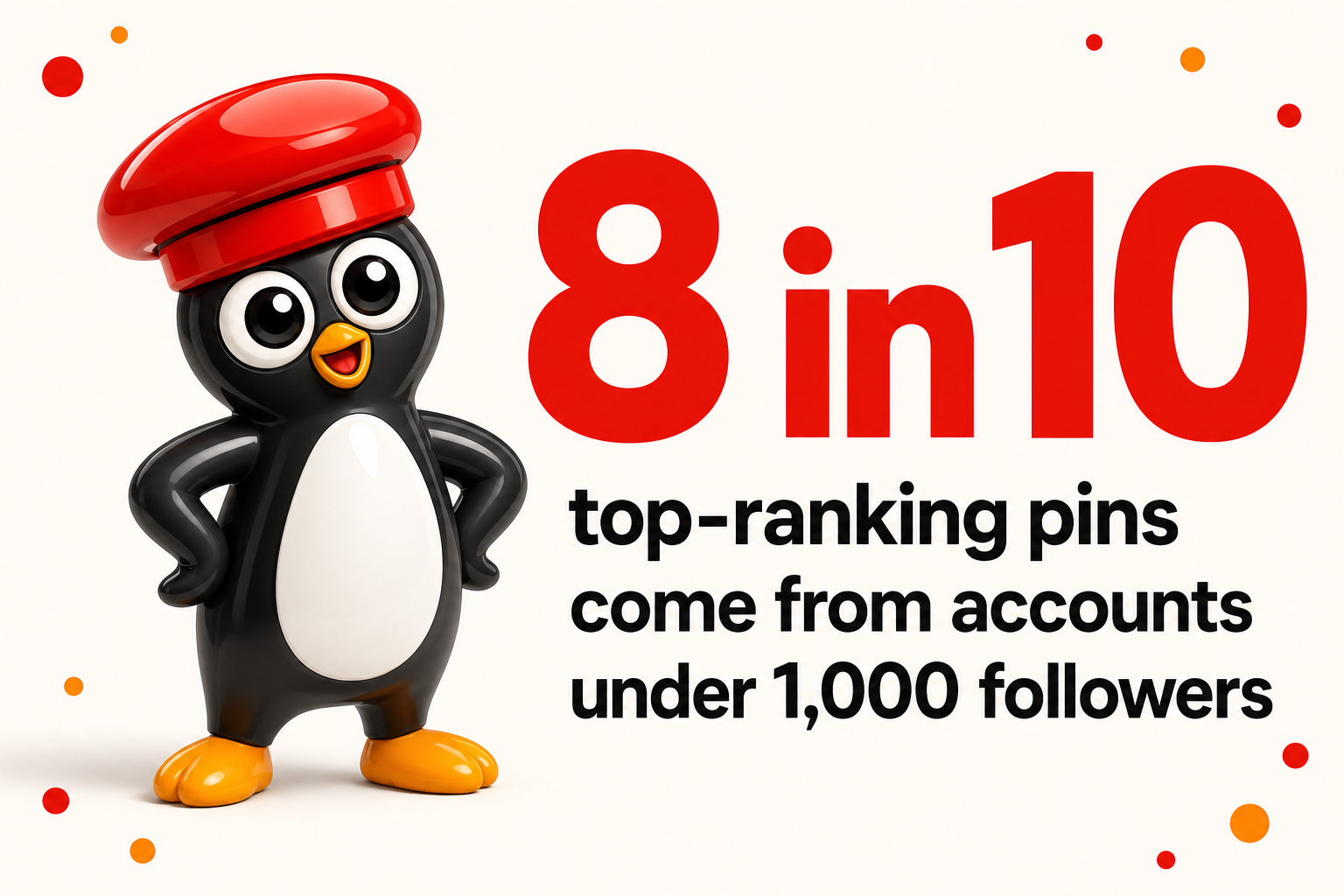
No. Accounts under 1,000 followers hold about 8 in 10 top-ranking spots.
We checked roughly 103 million ranked pins from about 13 million different Pinterest® accounts to see whether follower count lines up with where a pin lands in search. It barely does.
Small accounts publish 80% of everything that ranks, and they hold 80% of the top-10 positions. Across the entire follower range, from under 100 followers to over a million, the difference is a couple of positions at most.
Convinced you need more followers first?
Eight in ten top-ranking pins come from accounts with under 1,000 followers. Before you wait another month to grow, search your niche and look at the real accounts holding the spots you want. Free account, 7 days of Pro included, no credit card.
See Who’s Actually RankingKey findings
- Small accounts hold the top of search. Accounts with under 1,000 followers produce 80.1% of all ranked pins, and hold 79.7% of every top-10 position. That is almost exactly proportional, so they are not being filtered out at the top.
- The curve is nearly flat. Average position runs 48.8 for accounts under 1,000 followers and 45.9 to 47.7 for the largest accounts, a gap of roughly one to three positions depending on how you count. Reaching the top 10 goes from 11.7% to about 15%.
- There is no follower threshold. Accounts with fewer than 100 followers actually ranked slightly better (48.6) than accounts with 500 to 999 (49.1). Nothing unlocks at 1,000 or 10,000 followers.
- The follower edge is a head start, not a moat. On pins under 90 days old, large accounts reached the top 10 three points more often. By the time a pin is one to three years old, that gap is gone: 11.25% versus 11.32%.
- Followers matter most on crowded searches. On long-tail searches the gap between small and large accounts is small. On the busiest searches it nearly doubles.
- Idea pins reverse it entirely. Small accounts’ Idea pins reached the top 10 more often (12.8%) than Idea pins from accounts over 100,000 followers (11.9%).
- What you write tracks a far bigger gap. A pin from an account under 1,000 followers whose title contains the search phrase averaged position 38.1 and reached the top 10 24.8% of the time, against 48.1 and 13.1% for a million-follower account whose title did not.
What this means for you
If you have been waiting to grow your following before you take search seriously, the data says you do not have to wait. Accounts under 1,000 followers are not a fringe presence in Pinterest search results. They are the majority of them, at the top as much as anywhere else.
That does not mean followers count for nothing. There is a small, real edge, worth a couple of positions on average, and it is concentrated in two places: brand-new pins, and the most competitive searches. Both of those are worth knowing about, because both suggest a specific move rather than a vague one.
The move for a smaller account is to compete where the crowd is thinner. On long-tail searches, the phrases with real but modest demand, the gap between a small account and a large one is at its narrowest. On the busiest searches it is at its widest. Picking your searches deliberately does more for you than picking up followers.
And the lever that tracked the biggest difference we measured is not your account size at all. It is whether your title and description contain the words people are actually searching for, which we measured directly in where to put your keyword on Pinterest. A pin from a small account that names the search phrase outranked a pin from a million-follower account that did not.
Who is actually ranking on Pinterest?
Before the ranking question, the simpler one: whose pins even appear? Pinterest search is dominated by small accounts, by a wide margin.
| Account size | Ranked appearances | Share of all results |
|---|---|---|
| Under 1,000 followers | 75.1M | 80.1% |
| 1,000 to 10,000 | 12.4M | 13.3% |
| 10,000 to 100,000 | 3.6M | 3.8% |
| 100,000 to 1M | 1.2M | 1.3% |
| Over 1M | 1.4M | 1.5% |
Four in five ranked pins come from accounts with fewer than a thousand followers. Accounts over a million followers account for 1.5% of what you see in search. That alone reframes the question: Pinterest search is not a place where big accounts crowd everyone else out.
Does follower count change where you rank?
Hardly. We compared average position and how often each group reached the top 10. (Remember, a lower position is better, and a higher reach percentage is better.)
| Account size | Ranked appearances | Avg. position | Reached top 10 | Reached top 25 |
|---|---|---|---|---|
| Under 1,000 followers | 75.1M | 48.8 | 11.7% | 28.3% |
| 1,000 to 10,000 | 12.4M | 48.7 | 11.6% | 27.9% |
| 10,000 to 100,000 | 3.6M | 47.4 | 12.6% | 29.3% |
| 100,000 to 1M | 1.2M | 46.6 | 13.3% | 30.1% |
| Over 1M | 1.4M | 47.7 | 13.3% | 28.8% |
The whole range spans a couple of positions. There is a mild upward drift as accounts get larger, and the top row looks like it dips, but that row needs a caveat. Accounts with more than a million followers are genuinely rare: only 471 of them appear anywhere in our data, and they are almost all marketplaces and publishers rather than individual creators. One of them, Etsy’s main account, is on its own responsible for more than half the pins in that tier, and Etsy’s own average of 49.1 pulls the whole row down. Set the Etsy accounts aside and the largest group averages 45.9 and reaches the top 10 about 15% of the time, the best of any tier. So the dip is a quirk of who lives in that bucket, not evidence that huge accounts rank badly.
Broken into finer bands, the flatness is even clearer. Accounts with fewer than 100 followers averaged 48.6 and reached the top 10 11.95% of the time, slightly better on both counts than accounts with 500 to 999 followers (49.1 and 11.4%). There is no threshold where something unlocks. The gentle lift only begins somewhere around 10,000 followers, peaks in the 500,000 to 1M band, and then falls away again.
Small account? Start with the searches you can win.
The follower gap almost vanishes on long-tail searches and widens on the busiest ones, so which phrases you choose matters more than your size. Search your niche in Pinfluence Discover and see the phrases people actually use, plus the pins holding the top spots for each. Free account, 7 days of Pro included, no credit card.
Search Your Niche FreeWho actually holds the top 10?
This is the number worth remembering. If big accounts were quietly taking the best spots, small accounts would hold a smaller share of the top 10 than of results overall. They do not.
| Account size | Share of top-10 spots | Share of all results | Index |
|---|---|---|---|
| Under 1,000 followers | 79.7% | 80.1% | 0.995 |
| 1,000 to 10,000 | 13.0% | 13.3% | 0.98 |
| 10,000 to 100,000 | 4.1% | 3.8% | 1.07 |
| 100,000 to 1M | 1.5% | 1.3% | 1.13 |
| Over 1M | 1.7% | 1.5% | 1.13 |
Accounts under 1,000 followers hold 79.7% of top-10 positions while producing 80.1% of results, an index of 0.995. In plain terms, they take their spots at almost exactly the rate you would expect if follower count played no part at all. Large accounts do over-index, by about 13%, which is real but modest next to the common assumption that you need a following to be seen.
The same picture shows up in how spread out the winners are. More than 3.5 million different accounts hold at least one top-10 position in our data, and the 100 most successful accounts hold just 2.51% of those spots between them. The 1,000 most successful hold 5.72%. The top of Pinterest search is not concentrated in a handful of famous names.
Do big accounts just have older, more established pins?
This was the obvious objection, so we tested it. If large accounts only look better because their pins have had longer to settle in, the advantage should grow with pin age. It does the opposite.
| Pin age | Under 1,000 followers | Over 100,000 followers | Gap |
|---|---|---|---|
| Under 90 days | 13.00% | 15.97% | 3.0 points |
| 90 days to 1 year | 11.63% | 13.64% | 2.0 points |
| 1 to 3 years | 11.25% | 11.32% | 0.07 points |
| Over 3 years | 11.80% | 12.71% | 0.9 points |
The advantage is largest on brand-new pins and effectively disappears by the time a pin is one to three years old, where the two groups are within a rounding error of each other. So what a large following appears to buy is a head start, not a permanent position. A smaller account’s pin catches up as it ages, which fits what we found in our pin age study: older pins keep competing for a long time.
Where followers matter most: crowded searches
The other place the gap concentrates is competition. We split searches by how much demand they carry, and compared groups only within the same demand level, because busy searches return far deeper result sets and their raw positions are not comparable to quiet ones.
| Search demand | Under 1,000 followers | Over 100,000 followers | Ratio |
|---|---|---|---|
| Long-tail (quiet) | 12.0% | 13.5% | 1.1x |
| Mid-demand | 7.9% | 11.8% | 1.5x |
| Busiest searches | 5.0% | 9.0% | 1.8x |
On quiet, long-tail searches a large account is about 1.1 times as likely to reach the top 10 as a small one. On the busiest searches that stretches to roughly 1.8 times. Followers buy the most exactly where competition is fiercest, and almost nothing where it is not. For a smaller account, that is the practical instruction hiding in this study: the long tail is where you compete on level ground. (The busiest-search figures rest on smaller counts for the large-account group, so read that row as the direction of travel rather than a precise multiple.)
The exception: Idea pins
One format flips the pattern completely.
| Format | Under 1,000 followers | Over 100,000 followers |
|---|---|---|
| Idea pins | 12.80% | 11.87% |
| Standard image pins | 11.25% | 13.61% |
| Video pins | 8.51% | 9.61% |
With Idea pins, small accounts reached the top 10 more often than accounts over 100,000 followers did. The usual small edge for large accounts holds for standard image pins and video, but not here. Read alongside our format study, which found Idea pins take a bigger share of top results than their numbers suggest, this makes Idea pins the most level ground on the platform for a smaller account.
Followers versus what you write
Finally, the comparison that puts the whole thing in proportion. We looked at the same accounts split by whether the pin’s title contained the exact phrase someone searched for.
| Group | Avg. position | Reached top 10 |
|---|---|---|
| Under 1,000 followers, phrase not in title | 49.0 | 11.5% |
| Over 1M followers, phrase not in title | 48.1 | 13.1% |
| Under 1,000 followers, phrase in title | 38.1 | 24.8% |
| Over 1M followers, phrase in title | 41.6 | 18.2% |
A pin from an account with under 1,000 followers that names the search phrase in its title averaged position 38.1 and reached the top 10 nearly a quarter of the time. A pin from an account with more than a million followers that did not name the phrase averaged 48.1 and reached the top 10 13.1% of the time. Ten positions and nearly double the reach separate them, in favour of the small account.
Put the two levers side by side: the entire follower range tracked two or three positions, and naming the search phrase tracked about eleven. That is the same size of gap we measured in our keyword placement study, reproduced here on a much larger and more recent set of pins. Exact phrase matching is a strict test, so relatively few pins qualify, but the ordering is consistent and the counts behind it run into the millions.
Does it hold in every niche?
Yes, and in two niches it goes the other way.
| Niche | Under 1,000 | Over 100,000 | Gap |
|---|---|---|---|
| Food and drink | 48.5 | 46.6 | 1.9 |
| Home decor | 48.0 | 47.0 | 1.1 |
| Beauty | 49.6 | 48.0 | 1.6 |
| Art | 50.1 | 49.5 | 0.6 |
| Women’s fashion | 48.6 | 45.6 | 2.9 |
| Design | 49.2 | 48.4 | 0.8 |
| DIY and crafts | 48.0 | 47.6 | 0.4 |
| Event planning | 48.3 | 47.7 | 0.6 |
| Education | 48.6 | 49.6 | -0.9 |
| Quotes | 48.9 | 50.2 | -1.3 |
Every gap is under three positions. Women’s fashion is the most follower-favouring niche we measured; DIY and crafts is the most level. And in education and quotes the gap is negative, meaning accounts under 1,000 followers averaged a better position than accounts over 100,000. Whatever your niche, your follower count is not what decides the outcome.
How we did this
This study uses the Pinfluencing.com research index, which organizes public information from Pinterest® search results.
These cuts cover roughly 103 million ranked pins published by about 13 million different accounts, indexed through early August 2026. Each row records where a pin ranked for a given search, where 1 is the top.
- Follower counts are read at the time we saw the pin. An account that has grown since publishing is counted at today’s size, not the size it was when the pin went up.
- Accounts with no reported follower count are excluded from every comparison by account size, which leaves about 91% of pins. A stored zero means we do not know, not that the account has no followers. Note too that the largest tier is thin and lopsided: just 471 accounts exceed a million followers, and Etsy’s main account alone supplies over half of that tier’s pins, so we read that row with care rather than as a clean average of huge accounts.
- Busy and quiet searches are never compared directly. Busier searches return far deeper result sets, so average positions are only compared within the same level of demand.
- Naming the phrase is measured strictly. We look for the exact search phrase inside the title, so pins that are well written but phrased differently are not counted. That makes the keyword figures conservative rather than generous.
- This shows a connection, not a cause, and ranking is not the same as traffic. We measure where pins appear in the default logged-out view, roughly the first 100 results per search, not whether anyone clicks.
The accounts above you started somewhere too.
This study ran on the same index behind Pinfluence Discover. Search your niche and see the pins holding the top spots, the phrases they use, and how big the accounts behind them really are. Free account, 7 days of Pro included, no credit card.
Start With One KeywordFrequently asked questions
Do you need followers to rank on Pinterest?
No. In our data, accounts with under 1,000 followers hold 79.7% of all top-10 positions, almost exactly matching the 80.1% of results they produce. Follower count tracked a difference of only a couple of positions across the entire range.
Can a brand-new Pinterest account rank in search?
Our data says size is not the barrier. Accounts with fewer than 100 followers averaged position 48.6 and reached the top 10 nearly 12% of the time, slightly better than accounts with 500 to 999 followers. We measure account size rather than account age, but there is no follower level below which pins stop ranking.
How many followers do you need before your pins rank?
There is no threshold in the data. Ranking is flat from your first follower up to about 10,000, then improves very gently. Nothing unlocks at 1,000 or 10,000 followers.
Do big accounts dominate Pinterest search results?
No. Accounts over a million followers produce 1.5% of ranked pins and hold 1.7% of top-10 positions. More than 3.5 million different accounts hold a top-10 spot, and the 100 most successful accounts hold only 2.51% of them between them.
Does follower count matter more for competitive keywords?
Yes, this is where the gap concentrates. On quiet long-tail searches a large account was about 1.1 times as likely to reach the top 10 as a small one; on the busiest searches, roughly 1.8 times. Long-tail searches are the most level ground.
Do followers help more with some kinds of pins?
They help with standard image pins and video, but not with Idea pins. Idea pins from accounts under 1,000 followers reached the top 10 more often (12.8%) than Idea pins from accounts over 100,000 followers (11.9%).
If followers do not matter, why are my pins not ranking?
This study rules out one explanation, not all of them. The levers that tracked much bigger gaps in our research are what your pin says and which searches you are competing for. Naming the search phrase in the title tracked about eleven positions, against about one for the whole follower range.
What matters more than followers on Pinterest?
In our data, the words in the title and description. A pin from an account under 1,000 followers whose title contained the search phrase averaged position 38.1 and reached the top 10 24.8% of the time, against 48.1 and 13.1% for a million-follower account whose title did not.
About the data and Pinfluence Discover
Every number here comes from the Pinfluencing.com research index of public Pinterest® search results, indexed through early August 2026.
If your follower count is not the thing holding your pins back, the useful work is finding the phrases people search for in your niche and writing them into your titles and descriptions. Pinfluence Discover is built for that, with a free account that includes 7 days of Pro, then keyword searches every day, no credit card needed.
Pinfluence Discover
See what ranks in your niche, whatever your follower count.
Pinfluence Discover indexes 18M+ real Pinterest® keywords and the pins holding the top spots, follower counts included. Create a free account and see your niche in under 60 seconds.
Create Your Free AccountFree account with 7 days of Pro included. No credit card. Stay free or upgrade, your call.
The latest Pinterest® research

Pinfluence is a third-party analytics and research tool that surfaces and organizes publicly available information from Pinterest®. Pinfluence is not affiliated with, endorsed by, sponsored by, or otherwise connected to Pinterest, Inc. Pinterest, the Pinterest logo, and related marks are trademarks or registered trademarks of Pinterest, Inc.