
Pinterest® Research · Pinfluence Discover
Where Do Pinterest® Pins Link, and Does It Affect Ranking?
By Pinfluencing.com · Last updated
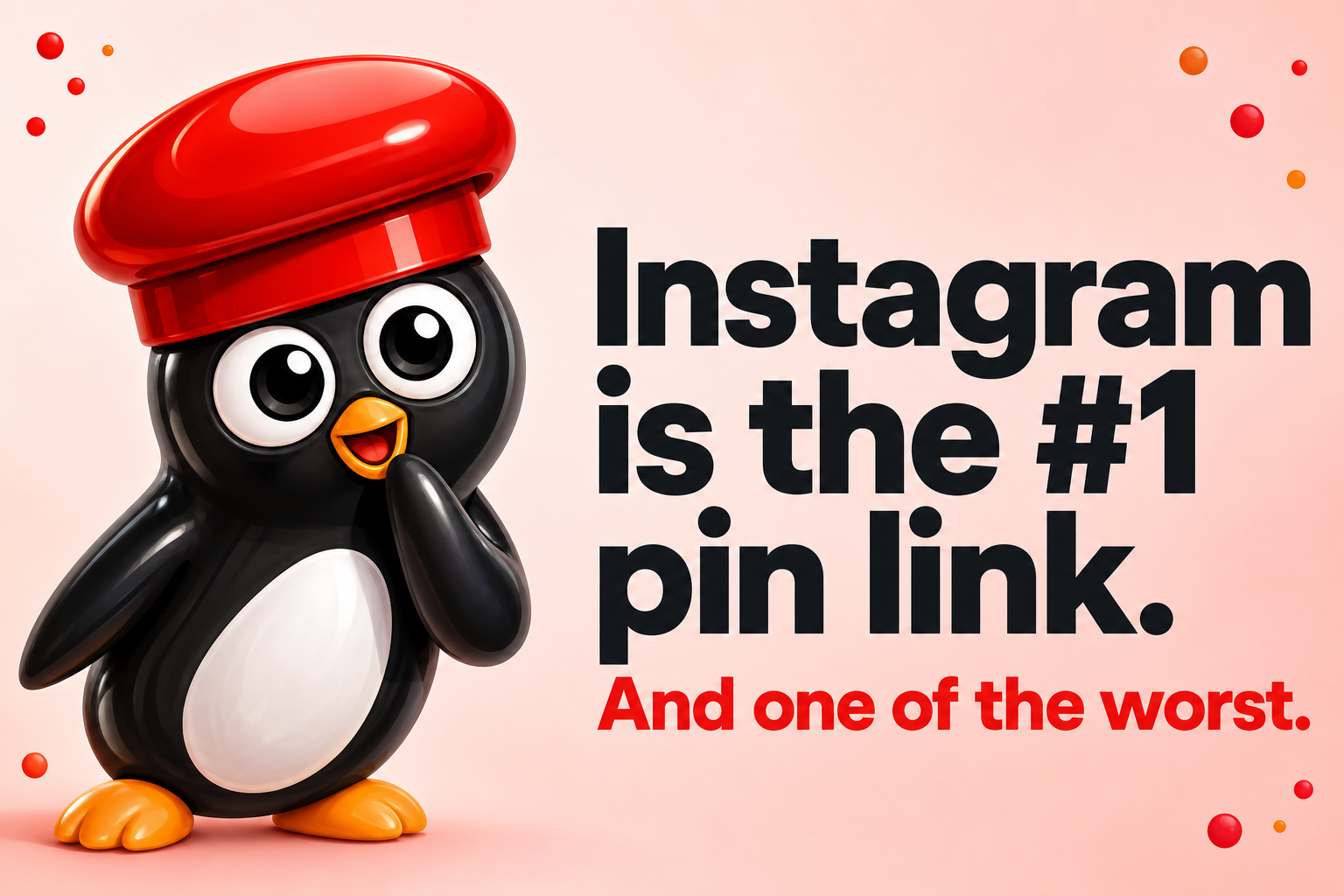
Most top pins do not link out. The ones that do mostly point to Instagram, which ranks poorly.
Only about 45% of Pinterest® pins carry an outbound link. Among those that do, Instagram is the number one destination by a wide margin, and the top destination in every niche.
Yet Instagram links rank poorly, and the data points at why: most arrive on autopilot, carrying captions instead of keywords. The links that rank best go to marketplaces like Poshmark, eBay, and Etsy. And whether linking out helps at all depends on your follower size.
Auto-publishing your Instagram to Pinterest?
Pinterest can turn every new Instagram post into a pin for you, caption and all. Convenient, but those captions were written for Instagram, not Pinterest search, and it shows in the ranking. Search your niche and see what the top pins say instead. Free account, 7 days of Pro included, no credit card.
See What Ranks InsteadKey findings
- Most pins stay on Pinterest. Only about 45% of pins carry an outbound link. The majority are native uploads with no clickthrough, heavily driven by Idea pins, which almost never link out.
- Instagram is the top destination, by a mile. Instagram is the single most common outbound domain, with more than 5 million ranked appearances, and it is the number one destination in every niche we checked.
- Instagram links rank poorly, though. Despite the volume, Instagram links reached the top 10 only about 8.2% of the time (average position 53.5), one of the weakest showings of any major destination.
- Auto-publishing explains a lot of the volume. Since mid-2024 Pinterest can turn every new Instagram post into a pin that links back to Instagram, and the big marketplaces have one-tap or scheduled sharing built in. A large share of Pinterest’s outbound links arrive on autopilot.
- Instagram links are also the least keyword-optimized. Only 0.4% of Instagram-linked pins carry the search phrase in their title, roughly a tenth of the marketplace rate. Captions are not search copy, and the ranking shows it.
- Marketplaces rank best. Links to Poshmark, eBay, Zazzle, and Etsy all reached the top 10 far more often (roughly 12% to 18%). Pinterest search clearly surfaces shoppable destinations well.
- Whether linking out helps flips with account size. Accounts under 10,000 followers ranked slightly better with link-less pins, while accounts over 10,000 ranked better when they linked out, and 8 in 10 of their pins do.
- Link behavior is niche-driven. Food (80% link out) and DIY (61%) funnel traffic to blogs, while entertainment (19%) and art (29%) stay on Pinterest.
What this means for you
If you are a smaller account, do not assume you must link out to win. In our data, accounts under 10,000 followers ranked slightly better with on-platform pins (native uploads and Idea pins) than with pins that linked off Pinterest.
If you run a larger account or an established site, linking out is not a handicap. Accounts over 10,000 followers actually ranked better when they linked out, and the vast majority of their pins do. These are the businesses and blogs using Pinterest as a referral channel successfully.
Be realistic about Instagram. Much of that link volume is automatic: since mid-2024, Pinterest can turn every new Instagram post into a pin that links back to Instagram, with the Instagram caption as the description. Convenient, but captions are not search copy, and those pins rank poorly in Pinterest search. If your goal is to be found, treat auto-published pins as a starting point, not a strategy.
And remember that where you link is not what gets you found. In our data, the words in the title and description tracked a far bigger ranking gap than the destination did, which we cover in where to put your keyword on Pinterest. A well-optimized pin that links to a blog tends to beat a poorly-optimized one that links to a marketplace.
How often do pins link off Pinterest?
Less than half the time. Most of what ranks in Pinterest search is content that keeps you on the platform.
| Group | Share of pins |
|---|---|
| With an outbound link | 44.6% |
| No outbound link (native uploads) | 55.4% |
The no-link majority is heavily an Idea-pin phenomenon. Idea pins are built to keep people on Pinterest, so only about 1 in 5 carries an outbound link, against roughly half of standard image pins. So a big chunk of Pinterest search is content with nowhere else to send you.
Does linking out affect ranking?
Overall, link-less pins rank a touch better, but that headline is misleading until you control for account size. (Remember, a lower position is better.)
| Account size | No link | Has link |
|---|---|---|
| All accounts | 48.0 | 48.9 |
| Under 1,000 followers | 47.3 | 48.4 |
| 1,000 to 10,000 | 47.8 | 49.0 |
| Over 10,000 | 47.9 | 46.8 |
The flip is the story. Small and mid accounts rank slightly worse when they link out, their best content is on-platform. But accounts over 10,000 followers rank better when they link out, and 8 in 10 of their pins do. The platform seems to reward smaller creators for staying on Pinterest, while letting established sites use it as a referral funnel. And as with the other levers we have measured, linking works at the door, not at the table: once a pin makes the top 10, linked and link-less pins sit at the same average spot inside it (about 5.4 to 5.5).
Wondering where your competitors send their traffic?
Look up the accounts winning your keywords and see where their pins point: their blog, their shop, or nowhere at all, plus the followers and reach behind them. Free account, 7 days of Pro included, no credit card.
Explore Top Accounts FreeWhich destinations win Pinterest search?
When pins do link out, where they point varies enormously, and so does how well they rank. Here are the biggest external destinations and how they do.
| Destination | Appearances | Avg. position | Reached top 10 | Reached top 25 |
|---|---|---|---|---|
| instagram.com | 5.4M | 53.5 | 8.2% | 22.2% |
| etsy.com | 1.8M | 48.5 | 12.4% | 27.8% |
| amazon.com | 655K | 52.6 | 8.5% | 23.0% |
| poshmark.com | 170K | 43.8 | 17.1% | 34.0% |
| ebay.com | 150K | 43.8 | 17.5% | 33.7% |
| zazzle.com | 130K | 46.1 | 14.2% | 29.9% |
| amzn.to (Amazon short links) | 211K | 46.7 | 13.5% | 30.8% |
Two patterns jump out. Instagram dominates by volume, more than triple the next destination, yet ranks worst of the group, reaching the top 10 only 8.2% of the time. Pinning Instagram links is hugely common and weakly rewarded.
Marketplaces are the opposite. Poshmark, eBay, Zazzle, and Amazon short links all reach the top 10 far more often than the social platforms, with Etsy close behind. Pinterest search clearly surfaces shoppable, commerce destinations well.
Why these destinations? Follow the auto-publish pipeline
The leaderboard makes more sense once you know how these pins get made. Most of the big destinations have a pipeline that creates Pinterest pins with little or no extra effort.
Instagram has the only true auto-publish pipe. Since June 2024, linking your Instagram account to Pinterest turns every new Instagram post into a pin automatically: the pin links back to the Instagram post and carries the Instagram caption as its description. (A late-2025 update lets creators point those pins at their own website instead, but linking back to Instagram was the default for well over a year.)
The marketplaces run on one-tap sharing and cash incentives. Poshmark has share-to-Pinterest built into its app, with a community habit of sharing daily. eBay’s Seller Hub can post new listings to social channels, Pinterest included, on a schedule. Etsy pays sellers 4% of the order back when a sale comes through a link they shared. Zazzle products carry share buttons and referral links. And in June 2026, Pinterest added Amazon Storefront linking, which applies a creator’s Amazon affiliate attribution automatically.
That pipeline difference also explains the ranking gap. Marketplace shares inherit product titles, which are written to be searched: brand, item, style, size. Auto-published Instagram pins inherit captions, which are not. Here is how big that difference is.
| Destination | Search phrase in title | In title or description |
|---|---|---|
| instagram.com | 0.4% | 2.1% |
| etsy.com | 4.7% | 5.9% |
| poshmark.com | 5.2% | 6.5% |
| ebay.com | 5.5% | 7.2% |
| zazzle.com | 3.1% | 4.4% |
| Amazon (incl. short links) | 2.2% | 4.1% |
| All other external links | 2.9% | 4.0% |
Instagram sits at the bottom on every measure: 0.4% of Instagram-linked pins carry the exact search phrase in the title, roughly a tenth of the Etsy, Poshmark, and eBay rate. Exact-phrase matching is a strict test, so every number here is small, but the order is the story, and it almost perfectly mirrors the ranking order. Pins that arrive with searchable product titles rank; pins that arrive with social captions do not.
Instagram is the top link in every niche
It is not close, and it is not niche-specific. Here are the top five destinations in each of the biggest niches, and Instagram is number one in every single row, from a small share in the most diverse niches to more than a fifth in the most Instagram-heavy ones.
| Niche | #1 | #2 | #3 | #4 | #5 |
|---|---|---|---|---|---|
| Art | instagram 23.1% | etsy 5.8% | behance 2.5% | flickr 1.1% | redbubble 1.1% |
| Beauty | instagram 22.2% | etsy 3.3% | creativebooster 1.8% | medium 1.8% | amazon 1.8% |
| Design | instagram 17.2% | behance 5.8% | etsy 3.7% | fiverr 1.4% | medium 1.0% |
| Event planning | instagram 17.0% | etsy 10.1% | zazzle 2.6% | amazon 2.5% | catchmyparty 1.3% |
| DIY and crafts | instagram 10.8% | etsy 7.3% | youtube (mobile) 2.6% | youtube 1.5% | facebook 1.5% |
| Women’s fashion | instagram 10.6% | amazon 4.8% | etsy 4.3% | sewmamasew 3.8% | poshmark 2.1% |
| Home decor | instagram 9.1% | etsy 4.8% | amazon 3.5% | courtneysworld 1.3% | wayfair 1.1% |
| Food and drink | instagram 4.8% | facebook 1.4% | cooktopcove 0.5% | etsy 0.5% | insanelygoodrecipes 0.4% |
So no matter your niche, the most common thing creators link to is Instagram, and Etsy is second or third almost everywhere. But the runners-up tell each niche’s story: Behance for designers and artists, YouTube for DIY tutorials, Wayfair for home decor, Zazzle for event invitations, Poshmark for fashion, and a scatter of individual recipe blogs in food.
How concentrated are each niche’s links?
Another way to see a niche’s character is how spread out its links are. Some niches funnel almost everything through a handful of big platforms; others scatter across a huge long tail of individual sites.
| Niche | Distinct domains | Top-10 domains hold | Instagram share |
|---|---|---|---|
| Food and drink | 115,571 | 9.3% | 4.8% |
| Home decor | 119,281 | 23.4% | 9.1% |
| DIY and crafts | 148,667 | 28.5% | 10.8% |
| Women’s fashion | 70,825 | 31.4% | 10.6% |
| Design | 138,363 | 33.0% | 17.2% |
| Event planning | 75,121 | 36.3% | 17.0% |
| Beauty | 49,045 | 36.9% | 22.2% |
| Art | 120,843 | 37.9% | 23.1% |
Food is in a league of its own: over a hundred thousand distinct domains, and the ten biggest hold barely 9% of the links, a long tail of individual recipe blogs. At the other end, art and beauty funnel more than a third of their links through just ten domains, mostly Instagram. Across all linked pins there are more than 780,000 distinct external domains, but the top 10 hold about 23% of the links: a dominant head over a very long tail. If you run your own site, the diverse niches are proof that independent blogs take real link share; in the concentrated niches, the big-platform habit leaves that field much thinner.
Link behavior by niche
Whether a niche links out at all is wildly variable, and it tracks how bloggable the topic is.
| Niche | Link out | Rank (link) | Rank (no link) |
|---|---|---|---|
| Food and drink | 80.1% | 48.4 | 47.5 |
| DIY and crafts | 60.7% | 47.7 | 48.0 |
| Home decor | 53.4% | 48.6 | 47.0 |
| Women’s fashion | 38.6% | 49.0 | 47.5 |
| Beauty | 31.3% | 50.9 | 48.5 |
| Art | 28.7% | 51.5 | 48.8 |
| Entertainment | 18.6% | 50.5 | 48.9 |
Food and DIY are blog-funnel niches, where linking out is the norm and the ranking cost of doing so is small. Entertainment, art, and beauty stay on-platform, and in those niches link-less pins rank clearly better. So the right move depends on your niche as much as your account size.
How we did this
This study uses the Pinfluencing.com research index, which organizes public information from Pinterest® search results.
These cuts cover roughly 100 million pins. The wider index behind our other studies is the same, about 128 million ranked appearances from roughly 1.3 million searches across 56 million unique pins, indexed through early July 2026. Each row records where a pin ranked for a given search, where 1 is the top.
- ‘No link’ means a genuine native upload. A no-link pin is one Pinterest marks as a native upload with no external source, so we are comparing real link-less pins to real linked ones.
- A few destinations are Pinterest’s own. Some pins technically carry an internal Pinterest link. We exclude those from the external-destination story so the winners are genuine outside sites.
- Link behavior is tangled up with format. Link-less pins are mostly Idea pins, which is why we control for follower size and read this alongside our format study.
- Subdomains are counted separately. Short links and mobile subdomains (for example Amazon and its short-link domain) are listed on their own rather than merged, so a single brand’s true total can be a bit higher than any one row.
- This shows a connection, not a cause, and ranking is not the same as traffic. We see where pins point, not whether anyone clicks. The default logged-out view, roughly the first 100 results per search. Follower-size comparisons use only pins with a real follower count.
Wherever your pins point, they need to be found first.
This study ran on the same index behind Pinfluence Discover. Search your niche and get the phrases people type plus the pins winning them, so the traffic you send to your blog or shop actually shows up. Free account, 7 days of Pro included, no credit card.
Search Your Niche FreeFrequently asked questions
Do pins that link off Pinterest rank worse?
It depends on your follower size. Overall, link-less pins ranked slightly better, but that flips with account size: accounts under 10,000 followers ranked a little better with on-platform pins, while accounts over 10,000 ranked better when they linked out.
What is the best domain to link to on Pinterest?
For ranking, marketplace destinations did best. Links to Poshmark, eBay, Zazzle, and Etsy reached the top 10 far more often than social platforms. Instagram, despite being the most common link, ranked poorly.
Why do Instagram links rank so poorly on Pinterest?
The strongest signal in our data is optimization. Most Instagram-linked pins arrive via auto-publishing and carry the Instagram caption as their text, and only 0.4% contain the search phrase in the title, roughly a tenth of the marketplace rate. Pins that are not written for search rarely rank in it.
Should I add a link to my Pinterest pins?
If you run a larger account or an established site, yes, linking out did not hurt and slightly helped. If you are a smaller creator, your on-platform pins may rank a touch better, so do not feel forced to link out to compete.
Is auto-publishing from Instagram to Pinterest worth it?
It is free distribution, so it rarely hurts to have the pins exist. But do not expect them to rank: auto-published pins carry Instagram captions rather than search phrases, and Instagram-linked pins were the least keyword-optimized, worst-ranking major group in our data. The pins you write for Pinterest are the ones that get found.
Which niches link off Pinterest the most?
Food and drink links out the most (about 80% of pins), followed by DIY and crafts (61%). Entertainment (19%) and art (29%) stay on-platform the most. Link behavior closely tracks how bloggable a niche is.
Does linking out drive traffic to my site?
We cannot say from this data. We measure search ranking, which is where a pin appears, not whether anyone clicks through. Ranking well and driving traffic are related but different things.
About the data and Pinfluence Discover
Every number here comes from the Pinfluencing.com research index of public Pinterest® search results, indexed through early July 2026.
Wherever your pins point, the work that gets them found is finding the phrases people search for in your niche and writing them into your titles and descriptions. Pinfluence Discover is built for that, with a free account that includes 7 days of Pro, then keyword searches every day, no credit card needed.
Pinfluence Discover
Know where the winners link. And what they rank for.
Pinfluence Discover indexes 18M+ real Pinterest® keywords and the pins holding the top spots, where they link included. Create a free account and see your niche in under 60 seconds.
Create Your Free AccountFree account with 7 days of Pro included. No credit card. Stay free or upgrade, your call.
The latest Pinterest® research
Pinfluence is a third-party analytics and research tool that surfaces and organizes publicly available information from Pinterest®. Pinfluence is not affiliated with, endorsed by, sponsored by, or otherwise connected to Pinterest, Inc. Pinterest, the Pinterest logo, and related marks are trademarks or registered trademarks of Pinterest, Inc.